

Teen Acne: Getting Ahead Before School Starts
Back-to-school season brings new classes, new schedules, sports, activities, school pictures—and sometimes, new breakouts. For teenagers who are already prone to acne, the weeks leading up to a new school year can be an especially important time to get their skin routine back on track.
Summer often changes everything. Teens may stay up later, spend more time outdoors, sweat more, travel, swim, skip their usual skincare routine, or experiment with new products. Add changing hormones and the stress of returning to school, and suddenly a few clogged pores can turn into a much bigger breakout.
The good news? You don’t have to wait until acne becomes severe before doing something about it.
At Personalized Skin Care in Fullerton, one of the most important things I teach teens and their parents is that getting ahead of acne is usually easier than trying to catch up with it later.
Why Does Teen Acne Often Flare Around Back-to-School?
Teen acne isn’t caused by one single thing. During adolescence, hormonal changes can stimulate the sebaceous glands to produce more oil. When excess oil combines with dead skin cells inside the pores, congestion can develop. Bacteria and inflammation may then contribute to the red, swollen blemishes we associate with acne.
Back-to-school season can add a few more challenges.
Hot weather and sweating are still common in Southern California. Sports practices begin. Teens may wear hats, helmets, headbands, or other equipment that traps heat and perspiration against the skin. Schedules become busier, sleep patterns change, and stress may increase. Skincare can quickly become an afterthought.
Start With the Basics—Not More Products
More isn’t always better.
A good teen skincare routine should be simple enough that a teenager will actually follow it consistently.
The exact routine should depend on the type of acne, oil production, sensitivity, lifestyle, and products already being used.
Don’t Strip Acne-Prone Skin
This is one of the most important lessons for teenagers.
Oily skin still needs a healthy skin barrier.
Over Cleansing, scrubbing aggressively, or applying too many drying acne treatments can leave the skin irritated and uncomfortable. When the skin barrier becomes compromised, the complexion may become red, flaky, sensitive, and dehydrated. The goal of acne care isn’t to make the skin feel “squeaky clean.” The goal is to manage excess oil and congestion while maintaining healthy, balanced skin.
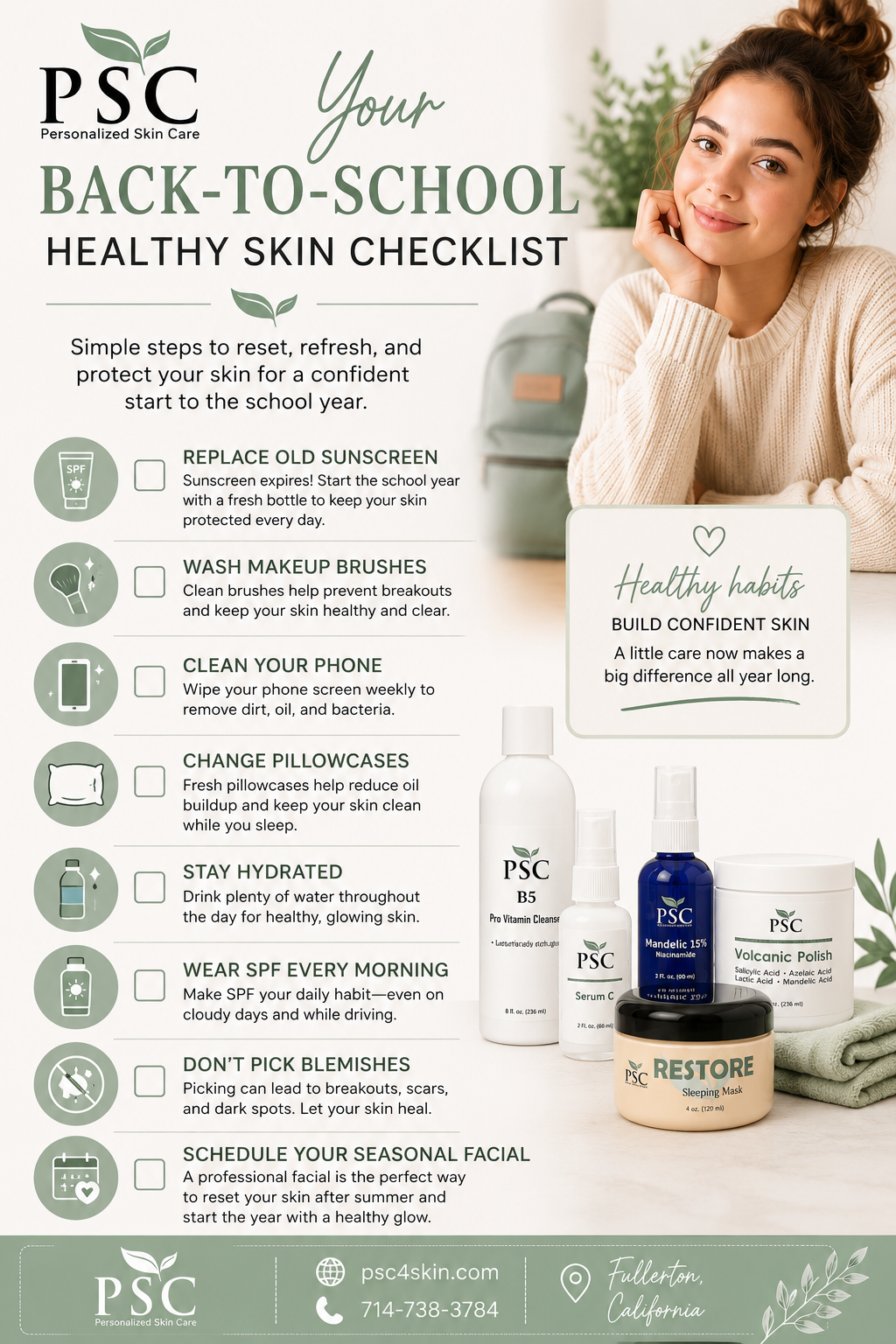
The Back-to-School Habits Teens Often Forget
Sometimes improving acne isn’t about buying anything new.
It’s about changing the things that repeatedly touch the face.
Clean Your Phone
Think about how many surfaces your phone touches—and how frequently you put it against your cheek. Clean the screen regularly and avoid resting your phone directly against the skin whenever possible.
Change Pillowcases Frequently
Oil, hair products, sweat, and skincare residue can accumulate on pillowcases. Changing them regularly is an easy habit for acne-prone teens.
Wash After Sports
Sweat itself isn’t necessarily the enemy, but leaving perspiration, oil, sunscreen, and dirt sitting on the skin after practice isn’t ideal. After sports or exercise, cleanse the face gently as soon as practical and change out of sweaty clothing.
Watch Hair Products
Pomades, oils, leave-in conditioners, and styling products can transfer onto the forehead and around the hairline.
If breakouts are concentrated in those areas, hair products are worth considering.
Don’t Share Makeup
Starting school often means getting ready with friends. Makeup brushes, sponges, and products that directly touch the skin shouldn’t be shared. And remember to clean your own brushes regularly.
Please Don’t Pick
I know this is easier said than done. A blemish appears the night before school pictures, a dance, a game, or an important event—and suddenly squeezing it seems like a good idea.
Usually, it isn’t. Picking and squeezing can increase inflammation and trauma to the surrounding skin. It can also increase the likelihood of lingering discoloration and, in some cases, scarring.
A pimple may last several days. The mark left behind can last much longer. If acne lesions are painful, deep, persistent, or beginning to scar, that’s also a sign that professional evaluation may be appropriate.
Be Careful With Social Media Skincare Trends
Teenagers today are exposed to more skincare information than any generation before them.
Some of that information is excellent. Some of it isn’t. A product may be popular online and still be completely wrong for your skin. Teens sometimes arrive with routines containing several exfoliating acids, retinoids, scrubs, acne treatments, masks, and serums—all being used at the same time. That can create irritation that looks like another skin problem. Instead of asking, “What’s trending?”, ask:
Why Starting Before School Matters
Acne treatments aren’t magic overnight solutions. Skin needs time. Starting a consistent routine before the school year gets fully underway gives you an opportunity to observe how the skin responds and make thoughtful adjustments. It also gives teens time to establish the routine as a habit.
Morning:
Cleanse with Facial Shampoo.
Evening:
Cleanse with Facial Shampoo
Scrub Clear Polish in gentle circular motion
Replenish the skin with Restore cream
Simple. The best skincare routine isn’t necessarily the most complicated one. It’s the one you’ll consistently use.
When Can a Professional Acne Facial Help?
Professional treatments can be particularly helpful when clogged pores, blackheads, whiteheads, or recurring congestion are present. At Personalized Skin Care, acne treatments are customized according to what we see in the skin. Depending on the teen’s needs, a treatment may focus on professional cleansing, careful extractions, exfoliation, calming the skin, or helping establish a more appropriate home-care routine. Just as importantly, an appointment gives us an opportunity to look at what the teen is already using. Sometimes the solution isn’t adding another product. Sometimes it’s simplifying the routine. For moderate-to-severe, painful, cystic, rapidly worsening, or scarring acne, an esthetician should not replace medical care. We may recommend evaluation by a dermatologist when appropriate. Professional skincare and medical dermatology can complement one another when necessary.
Parents: Help Without Making Acne the Conversation
Acne can affect much more than the surface of the skin. For a teenager, a breakout that seems minor to an adult can feel enormous—especially before the first day of school, school pictures, homecoming, or another social event. Try to make skincare supportive rather than critical.
Instead of:
“Your face is breaking out again.”
Try:
“Do you want some help figuring out what’s irritating your skin?”
Give teens ownership of their routine.
Keep it manageable.
And remember that perfection isn’t the goal.
Healthy skin is.
Lorena’s Professional Tip
One of the biggest mistakes I see with teen acne is waiting until the skin becomes very congested before starting a consistent routine. I would much rather help a teenager when we’re dealing with a few clogged pores than after weeks of picking, irritation, and increasingly aggressive products. Start simple, be consistent, and give the skin time to respond. If something isn’t working, don’t automatically use more of it. Sometimes the skin is telling us that it’s time to adjust the approach.
— Lorena Coello, Master Esthetician
Did You Know?
Acne doesn’t always mean the skin is dirty. Hormones, oil production, dead skin cells, inflammation, genetics, certain products, medications, and lifestyle factors can all influence acne. That’s why excessive washing isn’t the answer. In fact, aggressively cleansing or scrubbing acne-prone skin may simply create more irritation without addressing what’s happening inside the pore.
Get Ahead of the Breakouts
Don’t wait for the night before school pictures to start thinking about acne. If your teen is experiencing clogged pores, recurring breakouts, excess oil, or confusion about which products to use, we’re here to help.
At Personalized Skin Care (PSC Wellness) in Fullerton, we can evaluate the skin, simplify the home routine, and recommend a personalized approach based on what the skin actually needs.
Start the school year with a plan—not another random acne product.
Schedule a teen skincare consultation or acne facial with Personalized Skin Care.
714-738-3784
psc4skin.com
Fullerton, California
Serving clients since 1993, Personalized Skin Care Facials Fullerton—part of PSC Wellness—specializes in corrective, results-driven facials designed to transform your skin.
We focus on customized treatments based on your skin’s condition, not just your skin type. Whether you’re dealing with acne, aging, sensitivity, or compromised skin, our approach is centered on restoring skin function, strengthening the barrier, and delivering visible results—often in just one session.
As part of PSC Wellness, we take a more complete approach to skin health, combining advanced treatments with long-term skin solutions tailored to you.
Personalized Skin Care is not a one-size-fits-all experience—it’s a targeted skin solution built on over 30 years of expertise.
facials Fullerton, acne facial, anti-aging facialLearn more about our Facials:
FAQ
How often should a teenager wash their face?
For most teens, cleansing twice daily—morning and evening—is a good starting point. Cleansing after heavy sweating or sports may also be appropriate.
Should teens use moisturizer if they have oily skin?
Usually, yes. Oily skin can still become dehydrated or have a compromised barrier. The key is choosing hydration appropriate for acne-prone skin.
Does sunscreen make acne worse?
The wrong sunscreen may feel heavy or contribute to congestion for some people, but skipping sun protection isn’t the answer. Look for a sunscreen appropriate for acne-prone skin and wear it consistently.
Is scrubbing good for blackheads?
Aggressive scrubbing isn’t necessary and can irritate the skin. Blackheads form within the pore, so professional extractions and appropriate exfoliation may be more helpful than repeatedly scrubbing the surface.
How long does it take to improve teen acne?
There isn’t one timeline for everyone. Acne generally requires patience and consistent care rather than an overnight fix. If a routine isn’t improving the skin or acne is becoming more severe, seek professional guidance.
When should a teenager see a dermatologist?
Consider medical evaluation for deep or painful cysts, significant inflammation, scarring, rapidly worsening acne, acne that isn’t responding to appropriate care, or when the condition is causing significant distress.




Don’t wait for the night before school pictures to start thinking about acne.
If your teen is experiencing clogged pores, recurring breakouts, excess oil, or confusion about which products to use, we’re here to help.
At Personalized Skin Care (PSC Wellness) in Fullerton, we can evaluate the skin, simplify the home routine, and recommend a personalized approach based on what the skin actually needs.
Start the school year with a plan—not another random acne product.
Schedule a teen skincare consultation or acne facial with Personalized Skin Care.
714-738-3784
psc4skin.com
Fullerton, California
0 Comments